
“Childline offers free, confidential advice and support whatever your worry, whenever you need help.”Facebook must be stopped from creating hiding places for child abuse
NSPCC
over time
Every year keeps its colour across every chart.│ ChatGPT, 30 Nov 2022
174 of NSPCC's own blog posts, press releases and announcements, 2019 to 2026, measured sentence by sentence, 30 of them recovered from the Internet Archive. How the writing has moved over the years, how it compares with 9 other charities, and what it sounds like in its own words.
- Pages measured
- 174
- Years covered
- 2019–26
- Archived before ChatGPT
- 30
- Blog · press
- 43 · 131
01 · Homepage
One capture a year
NSPCC's homepage from 2000 to 2026, closest to 1 July, from the Internet Archive. Pick a year or press play. Each headline is quoted from its capture and links to the archived copy.
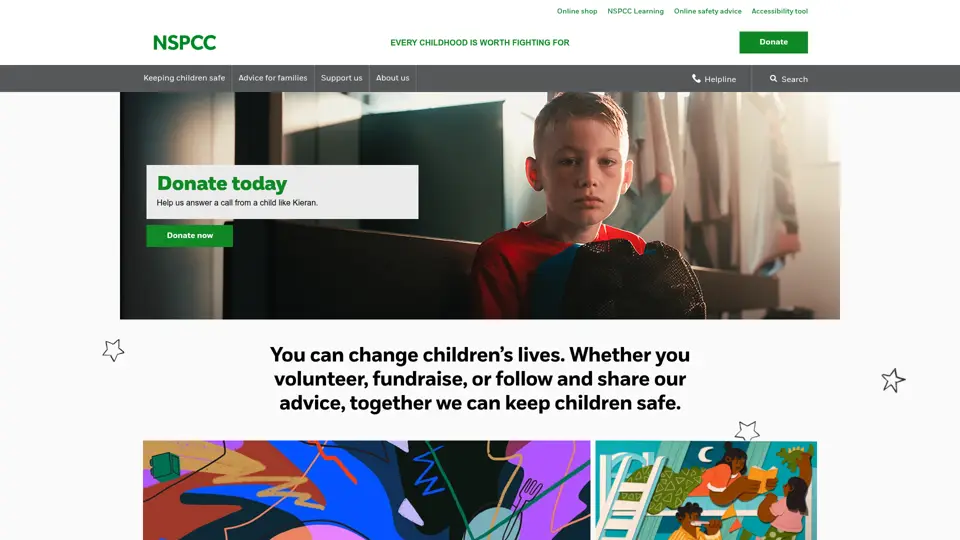
Screenshot of NSPCC’s homepage (nspcc.org.uk) as archived by the Internet Archive on 1 Jul 2026. © NSPCC or its licensors. Shown for comparison and review; not endorsed by NSPCC.
Homepage
2026
“What you can do”
Page title
NSPCC | The UK children's charity
- 2007More from the NSPCC
- 2012Children in care returned to abusive homes
- 2014Working to end child cruelty across the UK
- 2017Get ready for Messathon
- 2019Spotting the signs of child abuse
- 2025What you can do
24 captures. Screenshots are rendered from the archive and can pull in images archived later than the page itself; dates come from the capture. Years without a capture are greyed out in the strip.
02 · Measures by year
How the writing moved
Every year’s pages, averaged. Pick a measure. Hatched bars rest on fewer than 10 pages: context, not a finding. The page count sits under each year.
10 or more pagesFewer than 10 pages: context, not a findingSector averageChatGPT released
Show as a table
| Year | Sentence length | Pages |
|---|---|---|
| 2019 | 12.2 | 8 |
| 2020 | 11.9 | 6 |
| 2021 | 13.9 | 8 |
| 2022 | 12.7 | 8 |
| 2024 | 15.2 | 33 |
| 2025 | 14.4 | 40 |
| 2026 | 14.3 | 25 |
10 or more pagesFewer than 10 pages: context, not a findingSector averageChatGPT released
Show as a table
| Year | Sentence rhythm | Pages |
|---|---|---|
| 2019 | 0.91 | 8 |
| 2020 | 0.92 | 6 |
| 2021 | 0.83 | 8 |
| 2022 | 0.88 | 8 |
| 2024 | 0.75 | 33 |
| 2025 | 0.74 | 40 |
| 2026 | 0.74 | 25 |
10 or more pagesFewer than 10 pages: context, not a findingSector averageChatGPT released
Show as a table
| Year | Contractions | Pages |
|---|---|---|
| 2019 | 15.3 | 8 |
| 2020 | 16.6 | 6 |
| 2021 | 16.7 | 8 |
| 2022 | 19.9 | 8 |
| 2024 | 20.5 | 33 |
| 2025 | 21.4 | 40 |
| 2026 | 18.1 | 25 |
10 or more pagesFewer than 10 pages: context, not a findingSector averageChatGPT released
Show as a table
| Year | "You" | Pages |
|---|---|---|
| 2019 | 38% | 8 |
| 2020 | 37% | 6 |
| 2021 | 36% | 8 |
| 2022 | 31% | 8 |
| 2024 | 35% | 33 |
| 2025 | 41% | 40 |
| 2026 | 42% | 25 |
10 or more pagesFewer than 10 pages: context, not a findingSector averageChatGPT released
Show as a table
| Year | "We" | Pages |
|---|---|---|
| 2019 | 58% | 8 |
| 2020 | 56% | 6 |
| 2021 | 52% | 8 |
| 2022 | 56% | 8 |
| 2024 | 48% | 33 |
| 2025 | 46% | 40 |
| 2026 | 43% | 25 |
10 or more pagesFewer than 10 pages: context, not a findingSector averageChatGPT released
Show as a table
| Year | Questions | Pages |
|---|---|---|
| 2019 | 2.2 | 8 |
| 2020 | 4.1 | 6 |
| 2021 | 1.7 | 8 |
| 2022 | 2.0 | 8 |
| 2024 | 1.6 | 33 |
| 2025 | 1.9 | 40 |
| 2026 | 2.0 | 25 |
10 or more pagesFewer than 10 pages: context, not a findingSector averageChatGPT released
Show as a table
| Year | Exclamations | Pages |
|---|---|---|
| 2019 | 0.00 | 8 |
| 2020 | 0.00 | 6 |
| 2021 | 0.10 | 8 |
| 2022 | 0.14 | 8 |
| 2024 | 0.15 | 33 |
| 2025 | 0.09 | 40 |
| 2026 | 0.00 | 25 |
10 or more pagesFewer than 10 pages: context, not a findingSector averageChatGPT released
Show as a table
| Year | Long words | Pages |
|---|---|---|
| 2019 | 25% | 8 |
| 2020 | 26% | 6 |
| 2021 | 24% | 8 |
| 2022 | 26% | 8 |
| 2024 | 24% | 33 |
| 2025 | 25% | 40 |
| 2026 | 24% | 25 |
10 or more pagesFewer than 10 pages: context, not a findingSector averageChatGPT released
Show as a table
| Year | Em dashes | Pages |
|---|---|---|
| 2019 | 0.88 | 8 |
| 2020 | 1.03 | 6 |
| 2021 | 1.20 | 8 |
| 2022 | 0.52 | 8 |
| 2024 | 1.20 | 33 |
| 2025 | 1.85 | 40 |
| 2026 | 2.60 | 25 |
10 or more pagesFewer than 10 pages: context, not a findingSector averageChatGPT released
Show as a table
| Year | AI-associated words | Pages |
|---|---|---|
| 2019 | 0.00 | 8 |
| 2020 | 0.00 | 6 |
| 2021 | 0.73 | 8 |
| 2022 | 0.18 | 8 |
| 2024 | 0.56 | 33 |
| 2025 | 0.41 | 40 |
| 2026 | 0.36 | 25 |
10 or more pagesFewer than 10 pages: context, not a findingSector averageChatGPT released
Show as a table
| Year | AI-era marketing words | Pages |
|---|---|---|
| 2019 | 0.00 | 8 |
| 2020 | 0.00 | 6 |
| 2021 | 0.00 | 8 |
| 2022 | 0.00 | 8 |
| 2024 | 0.19 | 33 |
| 2025 | 0.14 | 40 |
| 2026 | 0.18 | 25 |
10 or more pagesFewer than 10 pages: context, not a findingSector averageChatGPT released
Show as a table
| Year | Quieter LLM-favoured words | Pages |
|---|---|---|
| 2019 | 0.00 | 8 |
| 2020 | 1.12 | 6 |
| 2021 | 1.30 | 8 |
| 2022 | 0.79 | 8 |
| 2024 | 1.04 | 33 |
| 2025 | 0.88 | 40 |
| 2026 | 0.42 | 25 |
10 or more pagesFewer than 10 pages: context, not a findingSector averageChatGPT released
Show as a table
| Year | AI-associated sentence shapes | Pages |
|---|---|---|
| 2019 | 0.17 | 8 |
| 2020 | 0.00 | 6 |
| 2021 | 0.13 | 8 |
| 2022 | 0.31 | 8 |
| 2024 | 0.06 | 33 |
| 2025 | 0.20 | 40 |
| 2026 | 0.20 | 25 |
10 or more pagesFewer than 10 pages: context, not a findingSector averageChatGPT released
Show as a table
| Year | Page length | Pages |
|---|---|---|
| 2019 | 676 | 8 |
| 2020 | 712 | 6 |
| 2021 | 937 | 8 |
| 2022 | 852 | 8 |
| 2024 | 978 | 33 |
| 2025 | 1,072 | 40 |
| 2026 | 1,039 | 25 |
Years with pages: 2019 (8), 2020 (6), 2021 (8), 2022 (8), 2024 (33), 2025 (40), 2026 (25). Dates come from page metadata, structured data, the URL, or the month a page was first archived (a latest possible date).
03 · Before and after
2019 to Nov 2022 against 2024 to 2026
The same measures on 30 pages from before ChatGPT launched and 98 pages from 2024 on. A change here is a change in style. It does not show how any page was written: people used every one of these words and shapes long before 2022, and SGR-011 found most of the shift across brands was a trend already under way.
Measure2019 to Nov 2022 · 30 pp2024 to 2026 · 98 ppChange
Sentence length
12.814.6+15%
Sentence rhythm
0.880.74−16%
Contractions
17.120.3+18%
"You"
35%39%+4 pts
"We"
56%46%−9 pts
Questions
2.41.8−24%
Exclamations
0.060.09+35%
Long words
25%25%−1 pts
Em dashes
0.901.82+102%
AI-associated words
0.240.45+85%
AI-era marketing words
0.000.17–
Quieter LLM-favoured words
0.780.82+5%
AI-associated sentence shapes
0.160.15−9%
Page length
8001,032+29%
Each row is scaled to its own larger value, so rows compare within themselves, not with each other. Before = 2019 to Nov 2022 (30 pages); after = 2024 to 2026 (98 pages). Method: SGR-011.
04 · Against its sector
NSPCC among charities
Each dot is one brand’s mean across all its measured pages; the tick is the sector average. Only brands with 10 or more measured pages are shown or counted. Select a dot to open that brand.
Contractions
71% more than its sector
21.7 against a sector average of 12.7; 2nd highest of 9.
"You"
42% more than its sector
47% against a sector average of 33%; 2nd highest of 9.
Questions
38% more than its sector
2.8 against a sector average of 2.1; 3rd highest of 9.
Pages measured: Cancer Research UK 133 · Oxfam 201 · British Red Cross 315 · Macmillan Cancer Support 290 · RNLI 35 · NSPCC 174 · Barnardo's 298 · Mind 228 · Save the Children 317 · RSPCA 3. Measures and method: SGR-010; the brand list and sectors come from SGR-009.
05 · Vocabulary
Words NSPCC uses more than its peers
The words this brand reaches for more often than the rest of its sector. This is subject matter more than voice.
child170.7 vs 25.7
abuse62.2 vs 4.2
advice82.6 vs 12.0
online86.9 vs 19.1
safety45.0 vs 4.9
concerns32.7 vs 2.0
children223.4 vs 96.0
worried29.7 vs 2.6
parents45.2 vs 9.0
police23.4 vs 1.4
safe46.5 vs 10.4
NSPCCSector peers
Uses per 10,000 words, ranked by weighted log-odds (Monroe et al. 2008) across 174 pages. Checked for product names and page furniture.
06 · In its own words
What it sounded like
Openings of real pages, quoted word for word, oldest first. Each links to the page, or to the Internet Archive’s copy when it has gone.
“Childline offers free, confidential advice and support whatever your worry, whenever you need help.”Half a million children suffer abuse in the UK every year
“Childline offers free, confidential advice and support whatever your worry, whenever you need help.”Half of secondary school teachers don’t feel confident delivering sex and relationships education
“The Voice of Online Youth is a new group of young people bought together to advise politicians, regulators, parents and professionals about the best way to protect children online.”Voice of Online Youth group: Making sure children's voices are heard
“In response, we launched a new Childline campaign encouraging boys to contact the service for help and support.”Childline research reveals boys are most vulnerable to ''sextortion''
07 · Every page
All 179 pages, by year
The full list behind every number above, with links to the live page or the archived copy. 174 count towards the measures; the rest were not measured (2 pdf report (annual report, info pack), 2 mostly short lines (lists, tables, link pages) rather than prose, 1 same text as an earlier page from this brand). Pages with no reliable date count in the overall numbers but in no year.
202625 pages
- Childline is here this summer to support children on body image issues and eating disorders2026 · press · 1,093 words
- Childline delivers thousands of counselling sessions about sexuality and gender identity2026 · press · 943 words
- Top 5 platforms and apps linked to online child sexual abuse2026 · press · 992 words
- Childline delivering over 50 suicide counselling sessions a day2026 · press · 1,515 words
- NSPCC mourns the death of Esther Rantzen2026 · press · 728 words
- Rise in children struggling with loneliness contacting Childline2026 · press · 1,116 words
- Contacts about child sexual abuse in the family home rise by over a fifth in a single year2026 · press · 1,166 words
- We’re calling for tech companies to block child sexual abuse images in real time2026 · press · 1,111 words
- More than half of all Childline counselling sessions support children with mental health struggles2026 · press · 1,188 words
- Free training launched to strengthen early years safeguarding skills2026 · press · 962 words
- Government must stand up to big tech or under 16s social media ban is coming, warns NSPCC CEO2026 · press · 898 words
- The government must be tougher on social media platforms to keep children safe2026 · press · 998 words
- The government must do more to ensure that Family Hubs reach struggling parents2026 · press · 944 words
- Three quarters of children would support film-style age ratings on social media2026 · press · 1,077 words
- Our Helpline refers 10 babies and infants every day2026 · press · 1,469 words
- Rise in reports to the NSPCC Helpline about children being left home alone2026 · press · 1,167 words
- https://www.nspcc.org.uk/about-us/news-opinion/2026/how-can-we-make-children-safe-online-our-next-steps2026 · press · 1,099 words
- Supporting your child with new social media changes2026 · press · 1,486 words
- A social media ban would punish teenagers for tech platform’s failures2026 · press · 1,029 words
- https://www.nspcc.org.uk/about-us/news-opinion/2026/chris-sherwood-response-social-media-ban2026 · press · 683 words
- We've seen a 10% increase in child protection concerns in sport2026 · press · 1,005 words
- Support available following the sentencing of Vincent Chan2026 · press · 546 words
- Childline counselling sessions about online child sexual abuse rise by 36%2026 · press · 1,096 words
- https://www.nspcc.org.uk/about-us/news-opinion/2026/were-looking-new-members-youth-online-safety2026 · press · 872 words
- Gladiators star Fury becomes NSPCC Campaigner for Childhood2026 · press · 784 words
202540 pages
- NSPCC responding to thousands of child protection concerns as Christmas countdown continues19 Dec 2025 · press · 1,085 words
- Thousands of children are turning to Childline to seek help for anger issues12 May 2025 · press · 1,123 words
- Parliamentarians come together to support our Six Point Plan to Protect Children13 Mar 2025 · press · 1,183 words
- More than 100 child sexual abuse image crimes being recorded by police every day18 Feb 2025 · press · 1,245 words
- Over three quarters of the UK public want child safety checks on new generative AI products28 Jan 2025 · press · 1,258 words
- Two thirds of UK adults believe the risk of children being abused increases over Christmas2025 · press · 1,045 words
- NSPCC Response to rise in extremist rhetoric and activity2025 · press · 550 words
- Bullying was the main concern for over 6,500 counselling sessions delivered by Childline last year2025 · press · 1,406 words
- We've appointed a new Chair of the Board of Trustees2025 · press · 769 words
- Our Helpline saw an almost 50% rise in contacts about children's welfare in sports last year2025 · press · 889 words
- Childline delivers thousands of counselling sessions to young people about sexuality and gender identity issues2025 · press · 915 words
- Neighbours report thousands of child neglect cases to the NSPCC Helpline2025 · press · 1,066 words
- Childline is hearing from young people about their worries around exam results day2025 · press · 1,188 words
- Update: Proposed changes at the NSPCC2025 · press · 579 words
- Children's online safety could provide £3 billion to UK businesses2025 · press · 1,398 words
- Majority of parents believe they had a safer, easier and better childhood than their children2025 · press · 944 words
- Anxiety is the most common mental health concern for children reaching out to Childline2025 · press · 1,161 words
- Artificial intelligence safety tips for parents2025 · press · 951 words
- Most parents believe physical punishment of children crosses the line2025 · press · 1,008 words
- Most UK adults believe emotional abuse in childhood can have a lasting psychological effect2025 · press · 1,191 words
- Over 120 charities unite in call for Ministers to put children's rights at the heart of UK law2025 · press · 1,093 words
- Our work to make change happen in Westminster2025 · press · 1,043 words
- Childline research reveals boys are most vulnerable to ''sextortion''2025 · press · 1,228 words
- Safeguarding reforms at risk as research highlights significant strain on home education staff of local authorities2025 · press · 1,068 words
- Proposed changes at the NSPCC2025 · press · 600 words
- Nearly 7,000 child sexual abuse cases stuck in courts2025 · press · 1,212 words
- Our Helpline expects a rise in home alone concerns this summer2025 · press · 1,210 words
- Rise in calls to Childline about exam and revision stress during the exam period last year2025 · press · 1,146 words
- 1 in 5 UK parents know a child who’s been blackmailed online2025 · press · 1,023 words
- Child neglect concerns the number one reason for adults reaching out to our Helpline2025 · press · 1,192 words
- Our Helpline is contacted more than 30 times a day about parental substance misuse2025 · press · 1,098 words
- Data shows how criminals are using private messaging platforms to manipulate and groom children2025 · press · 1,195 words
- Social media sites failing to protect girls from harm at every stage2025 · press · 1,185 words
- Domestic abuse contacts to our Helpline reach record high2025 · press · 927 words
- Childline prepares for rise in children reaching out about loneliness this summer2025 · press · 1,106 words
- Most safeguarding professionals support the end of physical punishment of children in England2025 · press · 1,287 words
- Childline expecting increase in contacts from children with concerns about going back to school2025 · press · 1,292 words
- How to protect your children's back-to-school photos2025 · press · 985 words
- Leading voices urge the Prime Minister to end physical punishment against children in England2025 · press · 1,351 words
- We've appointed Tracey Pritchard to lead our fundraising efforts2025 · press · 691 words
202433 pages
- Almost 40% of all our Helpline referrals involve children aged 5 and under11 Sep 2024 · press · 903 words
- 102% increase in the number of children in care in the past 12 years5 Sep 2024 · press · 777 words
- NSPCC CEO, Sir Peter Wanless, has announced he is stepping down4 Sep 2024 · press · 973 words
- New partnership as young people contact Childline about AI related sexual abuse, bullying and misinformation25 Jan 2024 · press · 1,313 words
- 78% of surveyed local authorities want to provide more support to children in care to reunite with their families17 Jan 2024 · press · 1,698 words
- NSPCC appoints new CEO Chris Sherwood2024 · press · 681 words
- We're calling for a national strategy for England on child neglect2024 · press · 1,279 words
- Large majority of secondary school teachers think students worry too much that exam results will determine their future2024 · press · 981 words
- Three in four parents of children under five years old are anxious about their child's mental health2024 · press · 1,139 words
- How to protect your child's back-to-school photos2024 · press · 892 words
- More than 70,000 children in England have a parent struggling with alcohol misuse2024 · press · 805 words
- We've seen a surge in concerns about children experiencing domestic abuse2024 · press · 908 words
- Our Helpline has seen a 65% increase in adult concerns about children being left home alone2024 · press · 963 words
- Childline expects more contacts from children this summer about body image and eating disorders2024 · press · 939 words
- We've appointed a new Director of Communications2024 · press · 670 words
- Childline receives nearly 40 contacts per day from children who feel unhappy2024 · press · 825 words
- We're launching our first Game Safe Cup2024 · press · 662 words
- Voice of Online Youth group: Making sure children's voices are heard2024 · press · 947 words
- Overwhelming majority of parents believe in-person play has a positive impact on their child’s wellbeing2024 · press · 1,016 words
- Our response to the Sara Sharif verdict2024 · press · 422 words
- Over 300% increase in contacts to our Helpline about physical punishment against children2024 · press · 1,043 words
- Rise in calls to Childline about in-patient mental health treatment2024 · press · 738 words
- As child abuse image crimes increase, we’re calling on Ofcom and tech companies to take action2024 · press · 912 words
- Increase in number of ''sextortion'' contacts received by Childline2024 · press · 905 words
- Introducing our inaugural gaming festival to help tackle child abuse2024 · press · 1,205 words
- As emotional abuse contacts rise, Childhood Day will raise funds for vital services2024 · press · 759 words
- How do children and parents feel about the impact of smartphones and social media?2024 · press · 2,149 words
- Children supports thousands of young people on gender and sexuality2024 · press · 681 words
- Families living in poverty struggling to access early childhood services2024 · press · 1,186 words
- Online grooming crimes against children increase by 89% in six years2024 · press · 1,041 words
- More than three quarters of the public would support a new law to end child poverty2024 · press · 1,124 words
- NSPCC Cymru fundraising chairman receives MBE in New Year Honours2024 · press · 735 words
- We're calling on the government to improve support for reunited families2024 · press · 1,000 words
20228 pages
- NSPCC mourns death of Queen Elizabeth II2022 · press · 396 words · archived
- Landmark Online Safety Bill published in parliament2022 · press · 695 words · archived
- Child sexual exploitation crimes up 10% in the last year2022 · press · 967 words · archived
- Half a million children suffer abuse in the UK every year2022 · press · 897 words · archived
- Child cruelty crimes surge by more than a fifth - we urgently need government action2022 · press · 1,137 words · archived
- Record numbers of children and young people affected by domestic abuse2022 · press · 1,096 words · archived
- We’re calling on the next Prime Minister to deliver radical reform of children’s social care2022 · press · 662 words · archived
- Half of secondary school teachers don’t feel confident delivering sex and relationships education2022 · press · 965 words · archived
20218 pages
- NSPCC Trustee, Albert Heaney, receives CBE in New Year Honours2021 · press · 421 words · archived
- Poll shows widescale public support for stronger laws to protect children from online abuse2021 · press · 863 words · archived
- Our abuse in education helpline receives hundreds of calls since launching in April2021 · press · 875 words · archived
- Last December was loneliest month for children contacting Childline2021 · press · 1,034 words · archived
- Record high number of recorded grooming crimes lead to calls for stronger online safety legislation2021 · press · 1,248 words · archived
- Anti-bullying advice and new insights from Childline2021 · press · 1,288 words · archived
- Online child abuse crimes have doubled in recent years and more must be done to protect children online2021 · press · 1,031 words · archived
- Childline delivers nearly 5,000 counselling sessions to children about eating and body image disorders2021 · press · 736 words · archived
20206 pages
- Police record over 10,000 online child sex crimes in a year for the first time3 Sep 2020 · press · 741 words · archived
- Online child grooming offences pass 10,0002020 · press · 1,000 words · archived
- Calls about domestic abuse highest on record following lockdown increase2020 · press · 905 words · archived
- Childline provides lifeline to thousands of children during coronavirus lockdown2020 · press · 725 words · archived
- Numbers contacting NSPCC about domestic abuse up by nearly 50%2020 · press · 525 words · archived
- 67 children a day helped by Childline for suicidal thoughts and feelings2020 · press · 373 words · archived
20198 pages
- Facebook must be stopped from creating hiding places for child abuse2019 · press · 785 words · archived
- Thousands of sexual offences against young children recorded by police2019 · press · 625 words · archived
- More young people turn to Childline over exam results2019 · press · 708 words · archived
- Over 9,000 police-recorded online child sexual abuse offences2019 · press · 659 words · archived
- Thousands of contacts to dedicated female genital mutilation helpline2019 · press · 463 words · archived
- Over 1 million children could be sidelined by NHS mental health plan changes2019 · press · 706 words · archived
- Recorded online sexual grooming crimes rise by a third2019 · press · 651 words · archived
- Childline sees over 6,000 counselling sessions about gender and sexual identity2019 · press · 812 words · archived
In the overall numbers, no year46 pages
- | NSPCC8 Sep 2026 · press · 310 wordsDate only from the page text, not metadata, URL or archive capture: in the overall numbers, not placed in a year
- Babies and cryingundated · blog · 1,430 wordsNo date found: in the overall numbers, not in any year
- Christmas storytelling ideas for your familyundated · blog · 719 wordsNo date found: in the overall numbers, not in any year
- PANTS: How to answer questions from your childundated · blog · 2,252 wordsNo date found: in the overall numbers, not in any year
- Christmas games for your familyundated · blog · 516 wordsNo date found: in the overall numbers, not in any year
- How can I help my child if they are being bullied?undated · blog · 1,777 wordsNo date found: in the overall numbers, not in any year
- Talk PANTS: Conversation to help keep children safeundated · blog · 1,375 wordsNo date found: in the overall numbers, not in any year
- Safe & Happy Sibling Bedroom Sharing: Tipsundated · blog · 1,526 wordsNo date found: in the overall numbers, not in any year
- Talk PANTS: a conversation to help keep children safeundated · blog · 893 wordsNo date found: in the overall numbers, not in any year
- Separation and divorce rights and responsibilitiesundated · blog · 1,723 wordsNo date found: in the overall numbers, not in any year
- Where can I find the PANTS book?undated · blog · 493 wordsNo date found: in the overall numbers, not in any year
- How to cope with toddler tantrumsundated · blog · 1,214 wordsNo date found: in the overall numbers, not in any year
- Make a wellbeing boxundated · blog · 1,210 wordsNo date found: in the overall numbers, not in any year
- Christmas jokesundated · blog · 589 wordsNo date found: in the overall numbers, not in any year
- Family Bereavement: How to support children through grief and lossundated · blog · 1,658 wordsNo date found: in the overall numbers, not in any year
- Understanding Sexual Behaviour in Childrenundated · blog · 1,498 wordsNo date found: in the overall numbers, not in any year
- Take 5 Secondsundated · blog · 622 wordsNo date found: in the overall numbers, not in any year
- How to talk to children about difficult topicsundated · blog · 1,725 wordsNo date found: in the overall numbers, not in any year
- Supporting your child as a young carerundated · blog · 983 wordsNo date found: in the overall numbers, not in any year
- Awgrymiadau ar adeiladu''r ymennyddundated · blog · 382 wordsNo date found: in the overall numbers, not in any year
- Anger management in children: how parents can helpundated · blog · 1,976 wordsNo date found: in the overall numbers, not in any year
- How to cope with parental lonelinessundated · blog · 2,280 wordsNo date found: in the overall numbers, not in any year
- Ultimate guide to working from home with childrenundated · blog · 1,366 wordsNo date found: in the overall numbers, not in any year
- Domestic abuse and violence: Parental Guidanceundated · blog · 1,146 wordsNo date found: in the overall numbers, not in any year
- How to bond with your babyundated · blog · 1,249 wordsNo date found: in the overall numbers, not in any year
- Get creative with rock paintingundated · blog · 1,044 wordsNo date found: in the overall numbers, not in any year
- Healthy relationshipsundated · blog · 1,935 wordsNo date found: in the overall numbers, not in any year
- Talking to children about racismundated · blog · 2,417 wordsNo date found: in the overall numbers, not in any year
- Christmas family activitiesundated · blog · 407 wordsNo date found: in the overall numbers, not in any year
- Carol's storyundated · blog · 901 wordsNo date found: in the overall numbers, not in any year
- How to support a child with depression or anxietyundated · blog · 1,630 wordsNo date found: in the overall numbers, not in any year
- Sexuality and sexual orientationundated · blog · 1,635 wordsNo date found: in the overall numbers, not in any year
- How to support someone experiencing domestic abuseundated · blog · 1,318 wordsNo date found: in the overall numbers, not in any year
- Gender identityundated · blog · 2,151 wordsNo date found: in the overall numbers, not in any year
- Sut i ymdopi pan fydd plant yn strancioundated · blog · 1,198 wordsNo date found: in the overall numbers, not in any year
- Edrychwch, Dywedwch, Canwch, Chwaraewchundated · blog · 1,345 wordsNo date found: in the overall numbers, not in any year
- Activities for kids at homeundated · blog · 895 wordsNo date found: in the overall numbers, not in any year
- PANTS guides and resourcesundated · blog · 1,226 wordsNo date found: in the overall numbers, not in any year
- Is my child ready to be home or out alone?undated · blog · 596 wordsNo date found: in the overall numbers, not in any year
- Supporting children through separation and divorceundated · blog · 2,531 wordsNo date found: in the overall numbers, not in any year
- Christmas card makingundated · blog · 633 wordsNo date found: in the overall numbers, not in any year
- Mental health and parentingundated · blog · 1,363 wordsNo date found: in the overall numbers, not in any year
- Look, Say, Sing, Play - Brain-building tipsundated · blog · 1,891 wordsNo date found: in the overall numbers, not in any year
- Helping a child with lonelinessundated · blog · 1,347 wordsNo date found: in the overall numbers, not in any year
- Press officeundated · press · 556 wordsNo date found: in the overall numbers, not in any year
- News and features from the NSPCCundated · press · 356 wordsNo date found: in the overall numbers, not in any year
Not measured5 pages
- Anxiety is the most common mental health concern for children reaching out to Childline2025 · press · 1,161 wordsSame text as an earlier page from this brand: only the earliest copy is measured
- Annual Report and Accounts 2024/252024 · info_pack · 35,688 wordsPDF report (annual report, info pack): listed, but kept out of every measure
- Annual Report and Accounts 2023/242023 · info_pack · 33,950 wordsPDF report (annual report, info pack): listed, but kept out of every measure
- gallery - dare to debateby Aug 2020 · press · 156 words · archivedMostly short lines (lists, tables, link pages) rather than prose
- Number Day resourcesundated · blog · 3,437 wordsMostly short lines (lists, tables, link pages) rather than prose
08 · Method
How this was measured
The pages
NSPCC's own blog posts, press releases and announcements, fetched from the live site in 2026 and from the Internet Archive for 2015 to November 2022. Homepages are shown as captures; product and help pages are not measured.
The measures
Code counts from ScriptGrain’s writing instruments: sentence length and rhythm, contractions, pronouns, punctuation, long words, and three published lists of AI-associated words. No AI model reads or judges any page.
What it cannot say
These measures describe style. They cannot tell who or what wrote a page, and nothing here says or implies that any brand used AI to write.
Sample sizes
Every number carries its page count. Years under 10 pages, and before-and-after comparisons with under 10 pages on a side, are shown as context only.
- Sentence length
- Average words per sentence.
- Sentence rhythm
- How much sentence length varies (standard deviation over mean). Higher reads less even.
- Contractions
- Contractions (we're, you'll, it's) per 1,000 words. A rough gauge of how conversational the writing is.
- "You"
- Share of I/we/you pronouns that are "you": how much the writing addresses the reader.
- "We"
- Share of I/we/you pronouns that are "we": how much the writing talks about the organisation.
- Questions
- Question marks per 1,000 words.
- Exclamations
- Exclamation marks per 1,000 words.
- Long words
- Share of words with seven or more letters.
- Em dashes
- Em dashes per 1,000 words.
- AI-associated words
- Words from SGR-007's three AI-associated lists, per 1,000 words. These are style markers that people used long before ChatGPT; a higher rate says nothing about who or what wrote the page.
- AI-era marketing words
- Marketing words that became more common in AI-era copy (seamless, elevate, unlock...), per 1,000 words. A style measure only.
- Quieter LLM-favoured words
- Everyday words language models are known to over-use, per 1,000 words. A style measure only.
- AI-associated sentence shapes
- Sentence patterns such as "not just X, but Y", found by ScriptGrain's cliche checker, per 1,000 words. A style measure only.
- Page length
- Average words per page.
Studies: SGR-009: Do brands in the same sector sound the same? · SGR-010: How UK brands write · SGR-011: Did brand writing change after ChatGPT?.